What Makes Quantarium Different from Other Blockchains?
.jpg)
Over the past decade, blockchain technology has evolved rapidly. Thousands of projects have emerged, each promising faster transactions, lower fees, or new decentralized applications.
However, one major technological shift is approaching that could redefine blockchain security entirely: quantum computing.
While most blockchains were designed before quantum computing became a realistic concern, new projects are beginning to consider the long-term implications of this technology.
One such project is Quantarium, a blockchain infrastructure designed with quantum-resistant security principles in mind.
The Problem with Traditional Blockchain Security
Most existing blockchains rely on classical public-key cryptography. Systems such as RSA or elliptic curve cryptography secure wallets and transactions across the network.
These systems are extremely secure today because classical computers cannot efficiently solve the underlying mathematical problems.
However, quantum computers may eventually change this assumption.
The Quantum Computing Factor
Quantum computers use qubits instead of traditional bits, allowing them to solve certain problems far faster than classical machines.
A famous quantum algorithm known as Shor’s Algorithm could theoretically break many classical encryption systems if sufficiently powerful quantum computers become available.
This possibility has led researchers to explore post-quantum cryptography (PQC), a new generation of encryption designed to remain secure even against quantum attacks.
How Quantarium Approaches the Problem
Quantarium is designed with long-term infrastructure security in mind. Rather than relying solely on legacy cryptographic systems, the project focuses on integrating quantum-resistant principles into its architecture.
The ecosystem includes multiple layers designed to support decentralized applications, digital assets, and secure communication.
The Quantarium Ecosystem
The Quantarium network supports multiple components within its ecosystem.
- Applications such as secure messaging and livestream services
- A quantum-resistant blockchain mainnet
- A multi-token ecosystem
- Secure wallet infrastructure
- Future exchange integration
This layered structure allows developers and users to interact with the network through various services built on top of the main infrastructure.
Why Long-Term Security Matters
Blockchain networks are designed to operate for decades.
Because transactions and data are permanently recorded, security decisions made today may affect the system far into the future.
Preparing for the evolution of computing technology is therefore essential for any blockchain that aims to become global digital infrastructure.
Conclusion
While many blockchain projects focus on short-term improvements such as speed or transaction costs, Quantarium emphasizes long-term resilience.
As quantum computing continues to develop, systems designed with quantum-resistant principles may play an increasingly important role in the future of digital infrastructure.

FAQ
What is a quantum-resistant blockchain?
A blockchain designed to remain secure even if quantum computers become powerful enough to break classical cryptography.
Why is post-quantum cryptography important?
Because quantum computers may eventually threaten traditional encryption systems.
Is quantum computing already a threat?
Not yet, but many researchers believe preparation should begin now because infrastructure systems must remain secure for decades.
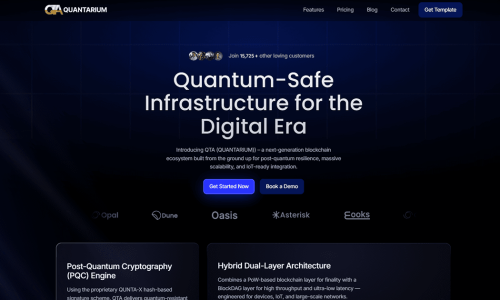
Quantarium Homepage - https://quantarium.io/
QUANTARIUM - Everything About Quantum Technology
Pantarium(Quantarium) Airdrop Page: Get 50 QTA for free immediately upon sign-up!
Earn additional rewards by sharing your referral code.

QR CHAT: The Beginning of New Communication!
Ringo Homepage!


댓글
댓글 쓰기