QRchat and Quantarium: Why Security Must Become the Default, Not the Exception
In most digital environments, security is treated as a conditional feature. Users apply it only when they perceive risk—during financial transactions, sensitive communications, or identity verification processes.
However, this assumption is fundamentally flawed. The reality is that users cannot reliably predict when a conversation will become sensitive or when data may be exposed.
QRchat, integrated with the Quantarium ecosystem, addresses this issue by redefining security as a default state rather than an optional layer.
The Problem with Conditional Security
Traditional messaging platforms operate on a model where data is continuously stored. Messages, metadata, and user relationships are recorded regardless of context.
Users are then expected to decide when to apply additional security measures. This creates a gap between perceived risk and actual risk.
In practice, most sensitive information is exposed not during high-alert situations, but during ordinary conversations that were never considered risky.

Unpredictability of Digital Risk
One of the core challenges in digital communication is unpredictability. A casual conversation can suddenly involve sensitive data such as personal identifiers, financial information, or confidential discussions.
Once this data is stored, it becomes part of a permanent record, increasing the long-term attack surface.
This makes reactive security insufficient.
QRchat’s Approach: Security as a Baseline
QRchat eliminates this uncertainty by removing persistent data storage altogether. Instead of asking users to decide when to be secure, it ensures that all interactions occur within a data-minimized environment.
This means that even ordinary conversations benefit from the same structural protection as sensitive ones.
Security is no longer an action—it becomes an inherent property of the system.
.jpg)
Layered Security with Securet
For scenarios that require an even higher level of protection, QRchat integrates Securet. This allows users to elevate security dynamically without leaving the platform.
This layered approach ensures flexibility while maintaining a strong baseline.
Quantarium: Extending Security to Economic Activity
Quantarium extends this philosophy beyond communication into the domain of digital assets and transactions.
As a PQC-based mainnet, it is designed to resist both current cryptographic threats and future quantum attacks.
When combined with QRchat, this creates a unified system where both communication and economic interactions are secured by design.
The Shift Toward Default Security
As digital systems evolve, the distinction between “secure” and “non-secure” modes is likely to disappear. Users will increasingly expect all interactions to be inherently protected.
QRchat and Quantarium represent an early implementation of this paradigm shift.
Conclusion
Security should not depend on user awareness or timing. It should be embedded into the system itself.
By making security the default state, QRchat eliminates the need for reactive protection strategies, while Quantarium ensures that this model extends into financial and transactional domains.
Final Insight: The future of digital systems belongs to those where security is not activated—it is assumed.
Quantarium Homepage - https://quantarium.io/
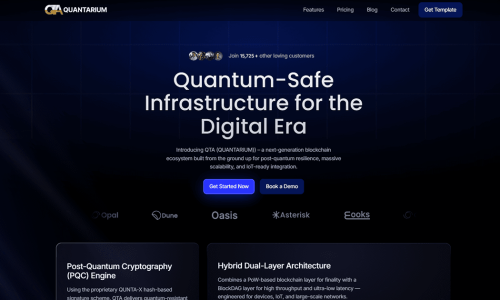
QUANTARIUM - Everything About Quantum Technology
Pantarium(Quantarium) Airdrop Page: Get 50 QTA for free immediately upon sign-up!
Earn additional rewards by sharing your referral code.

QR CHAT: The Beginning of New Communication!
Ringo Homepage!


댓글
댓글 쓰기