Will Quantum Computers Break Today’s Internet Security?
A Security Threat We Can No Longer Ignore
Quantum computing is no longer a theoretical concept confined to research labs. With major technology companies investing billions of dollars, the arrival of practical quantum computers is becoming inevitable.
This development raises a critical question: Will quantum computers break the security systems that protect today’s internet?
The short answer is: yes, if we do nothing.
The long answer requires understanding how modern cryptography works—and why quantum computing changes everything.


How Modern Internet Security Works Today
Most of today’s digital security relies on public-key cryptography, including:
- RSA encryption
- Elliptic Curve Cryptography (ECC)
- Digital signatures
These systems are secure only because certain mathematical problems are hard for classical computers to solve.



Quantum computing is no longer a theoretical concept confined to research labs. With major technology companies investing billions of dollars, the arrival of practical quantum computers is becoming inevitable.
This development raises a critical question: Will quantum computers break the security systems that protect today’s internet?
The short answer is: yes, if we do nothing.
The long answer requires understanding how modern cryptography works—and why quantum computing changes everything.

What Is Quantum Computing and Why Is It Different?
Unlike classical computers that process information using bits (0 or 1), quantum computers use qubits, which can exist in multiple states simultaneously.
Key characteristics of quantum computing:
- Superposition
- Entanglement
- Quantum parallelism
These properties allow quantum machines to solve certain problems exponentially faster than classical computers.
Unlike classical computers that process information using bits (0 or 1), quantum computers use qubits, which can exist in multiple states simultaneously.
Key characteristics of quantum computing:
- Superposition
- Entanglement
- Quantum parallelism
These properties allow quantum machines to solve certain problems exponentially faster than classical computers.

How Modern Internet Security Works Today
Most of today’s digital security relies on public-key cryptography, including:
- RSA encryption
- Elliptic Curve Cryptography (ECC)
- Digital signatures
These systems are secure only because certain mathematical problems are hard for classical computers to solve.

Why Quantum Computers Break These Assumptions
Quantum algorithms fundamentally change the rules.
Quantum algorithms fundamentally change the rules.
Shor’s Algorithm
- Efficiently solves integer factorization
- Breaks RSA and ECC
- Efficiently solves integer factorization
- Breaks RSA and ECC
Grover’s Algorithm
- Speeds up brute-force attacks
- Weakens symmetric encryption and hash functions
This means:
- Wallets can be stolen
- Transactions can be forged
- Digital identities can be compromised
- Speeds up brute-force attacks
- Weakens symmetric encryption and hash functions
This means:
- Wallets can be stolen
- Transactions can be forged
- Digital identities can be compromised

The “Harvest Now, Decrypt Later” Threat
One of the most underestimated risks is Harvest Now, Decrypt Later (HNDL).
Attackers can:
1. Collect encrypted data today
2. Store it for years
3. Decrypt it once quantum computers mature
This puts:
- Financial records
- Medical data
- Government communications
at long-term risk.
One of the most underestimated risks is Harvest Now, Decrypt Later (HNDL).
Attackers can:
1. Collect encrypted data today
2. Store it for years
3. Decrypt it once quantum computers mature
This puts:
- Financial records
- Medical data
- Government communications
at long-term risk.

Why Blockchain Is Especially Vulnerable
Blockchains are immutable.
This strength becomes a weakness in a quantum future.
If signatures used today become breakable:
- Old transactions remain exposed
- Dormant wallets become targets
- Network trust collapses
Blockchains are immutable.
This strength becomes a weakness in a quantum future.
If signatures used today become breakable:
- Old transactions remain exposed
- Dormant wallets become targets
- Network trust collapses
What Is Post-Quantum Cryptography (PQC)?
Post-Quantum Cryptography refers to cryptographic algorithms designed to resist quantum attacks.
Examples include:
- Hash-based signatures
- Lattice-based cryptography
- Code-based cryptography
Unlike RSA or ECC, these systems do not rely on problems solvable by quantum algorithms.
Post-Quantum Cryptography refers to cryptographic algorithms designed to resist quantum attacks.
Examples include:
- Hash-based signatures
- Lattice-based cryptography
- Code-based cryptography
Unlike RSA or ECC, these systems do not rely on problems solvable by quantum algorithms.
Global Response and Timeline
Governments are already reacting:
- NIST finalized PQC standards
- U.S. agencies mandated migration timelines
- Enterprises are preparing hybrid systems
Experts estimate 5–10 years for full transition—but preparation must begin now.
Governments are already reacting:
- NIST finalized PQC standards
- U.S. agencies mandated migration timelines
- Enterprises are preparing hybrid systems
Experts estimate 5–10 years for full transition—but preparation must begin now.

What Happens If We Don’t Act?
Failure to migrate means:
Failure to migrate means:
- Mass data exposure
- Financial system instability
- Loss of digital trust
Security transitions take years, not months.
- Financial system instability
- Loss of digital trust
Security transitions take years, not months.
Frequently Asked Questions (FAQ)
Will HTTPS become useless?
Not immediately, but current standards must be upgraded.
Are quantum computers already breaking encryption?
Not yet—but data collected today may be decrypted later.
Is PQC already available?
Yes. Standards and implementations exist today.
Will HTTPS become useless?
Not immediately, but current standards must be upgraded.
Are quantum computers already breaking encryption?
Not yet—but data collected today may be decrypted later.
Is PQC already available?
Yes. Standards and implementations exist today.
Conclusion: The Quantum Clock Is Ticking
Quantum computing is not a distant threat—it is a countdown.
The systems we trust today must evolve, or they will fail tomorrow.
The future of digital security depends on what we build now.
Quantum computing is not a distant threat—it is a countdown.
The systems we trust today must evolve, or they will fail tomorrow.
The future of digital security depends on what we build now.
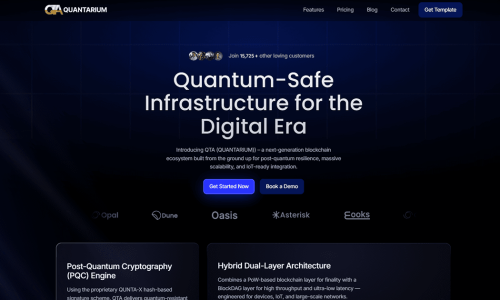
Quantarium Homepage - https://quantarium.io/
QUANTARIUM - Everything About Quantum Technology
Pantarium(Quantarium) Airdrop Page: Get 50 QTA for free immediately upon sign-up!
Earn additional rewards by sharing your referral code.
QR CHAT: The Beginning of New Communication!
Ringo Homepage!


댓글
댓글 쓰기