Why Quantum Computing Changes Blockchain Security — And Why Quantarium Matters
For more than a decade, blockchain innovation has focused primarily on performance. Developers and investors often discuss transaction throughput, fees, scalability, and network efficiency. While these factors are important, a more fundamental question is emerging as technology evolves:
Will today's blockchain security still work in a world with quantum computers?
Quantum computing represents one of the most significant technological shifts in modern cryptography. Although practical large-scale quantum computers are still under development, the theoretical implications are already clear. Many of the cryptographic systems used across the internet — including those used by blockchains — rely on mathematical assumptions that could become vulnerable in a quantum computing environment.

The Cryptographic Foundations of Modern Blockchain
Most blockchain networks rely on public-key cryptography to secure ownership of digital assets. When a user signs a transaction, they prove ownership of a private key corresponding to a public address. The security of this process depends on mathematical problems that are extremely difficult for classical computers to solve.
Two commonly used systems include:
- Elliptic Curve Digital Signature Algorithm (ECDSA)
- RSA-based cryptographic structures
Under classical computing conditions, deriving a private key from a public key would require an unrealistic amount of computational time. This assumption is what secures billions of dollars in digital assets today.
However, the introduction of quantum algorithms changes the equation.
How Quantum Computing Changes Cryptography
Quantum computers operate using quantum bits, or qubits, which allow certain types of calculations to be performed exponentially faster than classical computers.
One of the most famous quantum algorithms is Shor's Algorithm. This algorithm can theoretically solve the mathematical problems behind many public-key cryptographic systems dramatically faster than classical computers.
If sufficiently powerful quantum computers become available, they could potentially derive private keys from public keys used in blockchain transactions. This possibility introduces a long-term risk for blockchain security.
The Problem of Blockchain Immutability
Blockchain systems are intentionally designed to be immutable. Once data is written to the ledger, it cannot be modified. This property creates transparency and trust across decentralized networks.
However, immutability also introduces a unique challenge in the context of future cryptographic threats.
If a blockchain transaction was signed using a cryptographic method that later becomes vulnerable to quantum attacks, that signature remains permanently recorded in the blockchain. Even if the network later upgrades its cryptography, historical records may still contain vulnerable signatures.
This issue is sometimes referred to as cryptographic legacy risk.
The “Harvest Now, Decrypt Later” Threat
Security researchers often describe a scenario known as Harvest Now, Decrypt Later.
In this scenario, attackers collect encrypted data today with the intention of decrypting it in the future once more powerful computing resources become available. For blockchain systems, this means that publicly visible transaction data could potentially be analyzed in the future using quantum computing.
While the timeline for large-scale quantum computers remains uncertain, the risk is long-term. Infrastructure systems that aim to operate for decades must consider these possibilities during the design stage.
Why “Upgrading Later” May Not Be Enough
Many blockchain projects argue that they can simply upgrade to post-quantum cryptography in the future once quantum computers become a real threat. However, this approach introduces several limitations.
- Past signatures remain in historical blocks
- Migration across large networks is complex
- Legacy cryptographic exposure may remain
Because blockchain systems are designed for permanence, security decisions made during the early stages of a network can have consequences decades later.
The Post-Quantum Approach
Post-Quantum Cryptography (PQC) refers to cryptographic systems designed to remain secure even against quantum computers. These algorithms are currently being researched and standardized by organizations such as NIST.
Unlike traditional systems such as RSA or ECC, post-quantum cryptography typically relies on different mathematical structures that are believed to be resistant to quantum attacks.
This shift represents one of the most important upcoming transitions in global digital infrastructure.
.png)
Why Quantarium Matters in the Post-Quantum Era
Quantarium is designed around the assumption that future computing environments will be significantly more powerful than today's systems. Instead of relying on legacy cryptographic assumptions, the architecture focuses on long-term security principles aligned with post-quantum cryptography.
The goal is not simply to create another blockchain network, but to design infrastructure capable of surviving future technological shifts.
In a world where quantum computing may eventually transform cryptography, blockchain security must evolve beyond short-term performance metrics.
Speed, scalability, and efficiency remain important. However, the most important question may ultimately be survivability.
Quantarium represents an attempt to address that challenge by building blockchain infrastructure with the future of cryptography in mind.
Quantarium Homepage - https://quantarium.io/
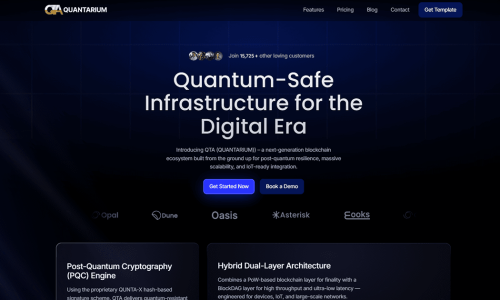
QUANTARIUM - Everything About Quantum Technology
Pantarium(Quantarium) Airdrop Page: Get 50 QTA for free immediately upon sign-up!
Earn additional rewards by sharing your referral code.

QR CHAT: The Beginning of New Communication!
Ringo Homepage!


댓글
댓글 쓰기