Security vs Anonymity vs Convenience: Rethinking Messaging Platforms with QRchat

Messaging platforms are often evaluated based on three key factors: convenience, security, and anonymity. While many applications attempt to balance these elements, very few are designed with security as a fundamental principle. Most platforms prioritize usability and feature integration, while treating security as an additional layer.
This distinction is critical. There is a fundamental difference between protecting data and eliminating data-related risk. QRchat represents a shift in this paradigm by focusing on structural security rather than traditional protection-based models.
Convenience-Oriented Messaging: Feature First
Platforms such as KakaoTalk are designed for ease of use and integration. They provide seamless communication, contact synchronization, and a wide range of features. This makes them highly effective for everyday communication.
However, this convenience is built on data. Messages, user information, and interaction history are stored on centralized servers. Security in this model depends on encryption, access control, and server protection.
While these measures can reduce risk, they cannot eliminate it. As long as data exists, it remains a potential target.
Security-Oriented Messaging: Protection Model
Some platforms attempt to improve security through encryption and enhanced privacy features. Telegram, for example, offers encrypted communication and optional secure chat modes.
However, even in these systems, data is often still stored. This means that security relies on protecting stored data rather than removing the underlying risk.
This model can be described as defensive security. It focuses on building stronger barriers around data.
QRchat: Security by Structure
QRchat introduces a fundamentally different model. Instead of protecting stored data, it removes data storage from the system entirely.
Messages are not retained, and there is no persistent communication history. Once a session ends, all data disappears. This eliminates the need for server-side protection and significantly reduces the attack surface.
In addition, QRchat uses a peer-to-peer (P2P) communication model. Messages are transmitted directly between devices without passing through centralized infrastructure. This further reduces potential points of failure.

Protection vs Elimination
The key difference between traditional messaging platforms and QRchat lies in how they approach risk.
- Convenience-focused platforms store data and protect it
- Security-focused platforms encrypt data but still store it
- QRchat removes data entirely
This represents a shift from protection-based security to elimination-based security.
If data does not exist, it cannot be stolen, leaked, or compromised. This principle is central to QRchat’s design philosophy.
Choosing the Right Approach
The choice of messaging platform depends on user priorities. For everyday communication, convenience may be the most important factor. For controlled environments, enhanced security features may be sufficient.
However, in situations where data exposure must be minimized, structural security becomes critical. In these cases, QRchat offers a distinct advantage.
Conclusion
The future of secure communication may not be about building stronger defenses, but about reducing the need for defense altogether.
QRchat demonstrates that security can be achieved not by protecting data, but by eliminating it.
Final Insight: True security is not about encryption alone—it is about removing the existence of risk.
Quantarium Homepage - https://quantarium.io/
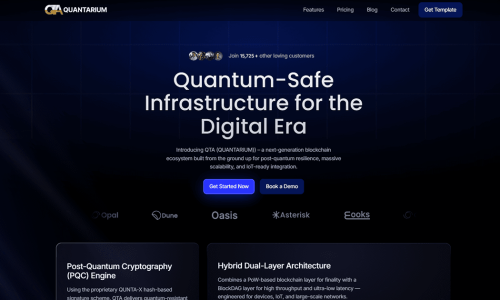
QUANTARIUM - Everything About Quantum Technology
Pantarium(Quantarium) Airdrop Page: Get 50 QTA for free immediately upon sign-up!
Earn additional rewards by sharing your referral code.

QR CHAT: The Beginning of New Communication!
Ringo Homepage!


댓글
댓글 쓰기