Can Digital Assets Survive the Quantum Era?

Digital assets have become one of the most important innovations of the modern internet. Cryptocurrencies, tokenized assets, and decentralized financial systems are increasingly built on blockchain networks that rely heavily on cryptographic security.
The assumption behind this security model is simple: the mathematical problems used in modern cryptography are extremely difficult for classical computers to solve. This assumption has protected the internet for decades.
However, the rapid development of quantum computing is beginning to challenge this long-standing assumption.
The Cryptographic Foundation of Digital Assets
Blockchain systems use public-key cryptography to secure ownership and verify transactions. Private keys allow users to sign transactions, while public keys enable the network to verify authenticity without revealing sensitive information.
This system has proven reliable in the classical computing era. Breaking these cryptographic protections using conventional computers would require an enormous amount of time and computational power.
But the security assumptions of the past may not hold forever.
The Quantum Computing Transition
Quantum computers operate using quantum bits and quantum mechanical principles, which allow certain calculations to be performed in fundamentally different ways.
One of the most widely discussed theoretical developments is Shor’s algorithm, which demonstrates how sufficiently powerful quantum computers could solve specific mathematical problems—such as integer factorization—far more efficiently than classical machines.
While large-scale quantum computers capable of breaking modern cryptography do not yet exist, governments and technology organizations are already preparing for the transition to quantum-resistant security systems.
NIST and the Global Shift to Post-Quantum Cryptography
The transition toward quantum-resistant security is already underway at the institutional level. The U.S. National Institute of Standards and Technology (NIST) has finalized the first set of Post-Quantum Cryptography (PQC) standards designed to protect digital systems against future quantum attacks.
These standards represent a global effort to redesign cryptographic systems before quantum computing becomes capable of breaking existing encryption methods. Governments, infrastructure providers, and cybersecurity researchers are actively exploring how to integrate PQC into next-generation digital systems.
The Long-Term Risk for Blockchain Systems
Blockchain networks present a unique challenge in the quantum transition. Unlike traditional systems, blockchain data is designed to be permanent. Transactions recorded today may remain accessible for decades.
If future computing technologies were able to compromise certain cryptographic assumptions, historical data stored on public networks could become vulnerable. This long-term horizon makes blockchain security fundamentally different from most traditional IT systems.
Designing Blockchain Infrastructure for the Quantum Era
Preparing blockchain networks for future computing environments requires more than incremental upgrades. It requires rethinking the architecture of digital security itself.
This includes exploring post-quantum cryptographic models, redesigning key management structures, and integrating security layers that can remain resilient as computational capabilities evolve.
.png)
The Quantarium Approach
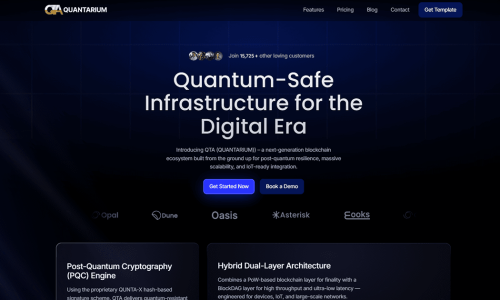
Quantarium approaches blockchain infrastructure from this long-term security perspective. Instead of focusing solely on short-term performance, the project explores how blockchain systems can evolve to remain secure in a future computing landscape shaped by quantum technologies.
By incorporating post-quantum security concepts and developing an ecosystem that includes secure communication tools such as Secure Trade Chat and Secure TV, Quantarium aims to create a digital environment where assets, transactions, and data interactions can remain protected as computing technology advances.
In a world where digital assets increasingly represent real economic value, the question is no longer whether quantum computing will influence security architecture—but whether digital infrastructure is prepared for that transition.
Quantarium Homepage - https://quantarium.io/
QUANTARIUM - Everything About Quantum Technology
Pantarium(Quantarium) Airdrop Page: Get 50 QTA for free immediately upon sign-up!
Earn additional rewards by sharing your referral code.

QR CHAT: The Beginning of New Communication!
Ringo Homepage!


댓글
댓글 쓰기