Can Bitcoin Survive the Quantum Era?

Bitcoin is often described as one of the most secure digital systems ever created. Its decentralized architecture and cryptographic foundation have protected billions of dollars in value for more than a decade.
However, as quantum computing research advances, an important question is beginning to appear in discussions about the future of digital assets: can Bitcoin remain secure in the age of quantum computing?
The Cryptography Behind Bitcoin
Bitcoin relies on public-key cryptography to secure transactions and verify ownership of funds. When a user sends Bitcoin, the transaction is signed with a private key and verified by the network using a corresponding public key.
This mechanism ensures that only the rightful owner of a wallet can authorize transactions.
Currently, Bitcoin primarily relies on cryptographic algorithms such as ECDSA (Elliptic Curve Digital Signature Algorithm). These systems are considered extremely secure when facing classical computers.
The Quantum Computing Question
Quantum computers operate in fundamentally different ways from traditional computers. By using quantum bits and quantum algorithms, they may eventually be able to solve certain mathematical problems more efficiently than classical machines.
One theoretical concern is that advanced quantum algorithms could weaken the security assumptions behind certain cryptographic systems used today.
While large-scale quantum computers capable of doing this do not yet exist, the possibility has led researchers and security experts to begin exploring quantum-resistant cryptographic systems.
The Transition Toward Post-Quantum Security
To prepare for future computing environments, researchers have developed Post-Quantum Cryptography (PQC). These cryptographic approaches are designed to remain secure even if quantum computers become powerful enough to challenge classical encryption systems.
Global organizations such as the U.S. National Institute of Standards and Technology (NIST) are already working to standardize PQC algorithms for future digital infrastructure.
What This Means for Blockchain Networks
For blockchain systems, the transition toward quantum-resistant security could become an important design consideration.
Because blockchain networks store long-term transaction records and manage digital assets with real economic value, ensuring the future security of these systems is essential.

The Quantarium Perspective
Quantarium approaches this challenge through a PQC-oriented blockchain mainnet architecture.
Instead of relying solely on classical cryptographic models, the Quantarium network explores integrating quantum-resistant security concepts directly into blockchain infrastructure.
The network is designed to support digital assets, token issuance, and decentralized services while preparing for future developments in computing technology.
In addition, the Quantarium ecosystem includes secure communication tools such as QR Chat, Securet messenger, and Securet TV, which aim to protect information exchange between users as part of a broader security environment.
As digital assets continue to grow in global importance, preparing blockchain infrastructure for future technological shifts may become one of the defining challenges of the next generation of crypto networks.
Quantarium Homepage - https://quantarium.io/
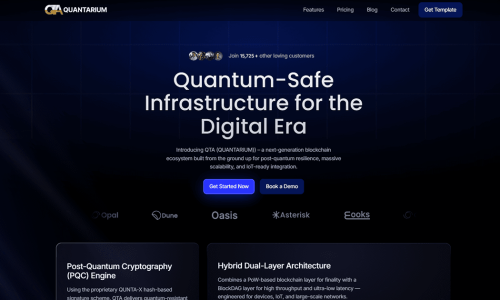
QUANTARIUM - Everything About Quantum Technology
Pantarium(Quantarium) Airdrop Page: Get 50 QTA for free immediately upon sign-up!
Earn additional rewards by sharing your referral code.

QR CHAT: The Beginning of New Communication!
Ringo Homepage!


댓글
댓글 쓰기