Beyond Security: Why Quantarium Was Designed for the Post-Quantum Era
Beyond Security: Why Quantarium Was Designed for the Post-Quantum Era
For years, blockchain discussions have focused on transaction speed, fees, and scalability. These metrics matter, but they ignore a more fundamental question: will today’s security assumptions still hold tomorrow?
Quantarium starts from a different premise: quantum computing is inevitable, and long-term infrastructure must be designed to survive it. That is why Quantarium positions itself as a post-quantum blockchain architecture built around long-term cryptographic survivability rather than short-term trends.

Why Quantum Computing Changes the Security Conversation
Modern blockchain security depends heavily on public-key cryptography. In practice, most networks rely on signature schemes built on assumptions that classical computers cannot efficiently break.
Quantum computing challenges that foundation. In particular, quantum algorithms such as Shor’s algorithm can, in principle, undermine classical public-key systems by changing what is computationally feasible. Even if large-scale quantum attacks are not immediate, the direction is clear: infrastructure systems that must last for decades cannot assume today's cryptography will remain safe forever.
The Hidden Risk: Blockchain Immutability and “Security Debt”
Blockchains are immutable by design. Immutability builds trust by ensuring that past records cannot be altered. However, this feature also creates a unique form of risk: if early cryptography becomes vulnerable in the future, historical transactions and signatures can remain exposed permanently.
This is often described as quantum legacy vulnerability: a scenario where the security assumptions behind historical blockchain data fail at some point in the future, while the records themselves remain permanently accessible.
Why “We’ll Upgrade Later” Is Not a Complete Strategy
Many projects claim they can migrate to post-quantum cryptography later. The challenge is not only the technical upgrade itself, but the cryptographic legacy left behind. A migration does not erase the past; it can only protect the future.
If a network’s early history depends on cryptographic systems that become weak, attackers may have incentives to target dormant assets, historical signatures, or exposed key material tied to earlier transactions. In that sense, upgrade-based security can create an illusion of safety while leaving long-term survivability unresolved.

Quantarium’s Design Philosophy: Security as Infrastructure
Quantarium treats security as infrastructure, not as an optional feature. Instead of building first and patching later, it assumes the post-quantum era from the beginning.
This approach aims to remove cryptographic legacy debt by ensuring that the network’s foundational security model aligns with long-term survivability requirements. In other words, Quantarium is designed around the question: “Will this still be secure when computing capabilities are radically different from today?”
What “Beyond Security” Means in Practice
“Beyond security” is not a marketing phrase. It reflects a design priority: survivability over short-term optimization. If a system fails its security assumptions, speed and low fees no longer matter.
Quantarium’s positioning focuses on the long-term role of blockchain as infrastructure: a foundation for assets, records, and value that must remain trustworthy over many years.

Conclusion
The next era of blockchain innovation will not be defined only by performance metrics. It will be defined by whether networks can remain trustworthy as computing changes.
Quantarium was designed for this reality: a post-quantum world where long-term cryptographic survivability becomes the primary requirement for digital infrastructure.
Quantarium Homepage - https://quantarium.io/
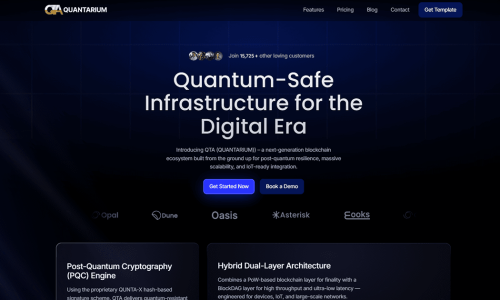
QUANTARIUM - Everything About Quantum Technology
Pantarium(Quantarium) Airdrop Page: Get 50 QTA for free immediately upon sign-up!
Earn additional rewards by sharing your referral code.

QR CHAT: The Beginning of New Communication!
Ringo Homepage!


댓글
댓글 쓰기